
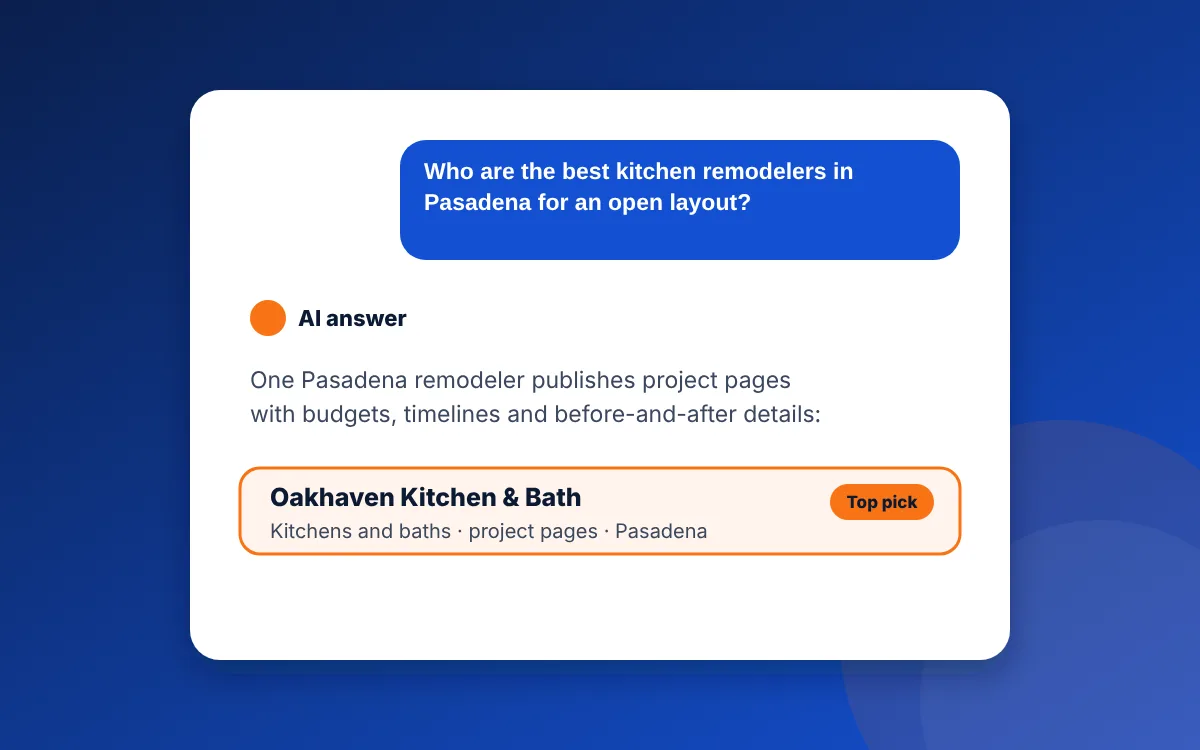
AI tools recommend remodelers that publish specific, checkable proof: project pages that name the room, the town and what changed, honest cost ranges, a clear process, and the same details on review sites and trade directories. Photo galleries with no words give them nothing to read.
What homeowners ask AI about remodeling
Remodeling prompts are research questions more than emergencies:
- "What does a mid-range kitchen remodel cost in Los Angeles in 2026?"
- "How long does a bathroom remodel take, and can we live in the house?"
- "Best remodelers in Pasadena for a kitchen with an island and new layout?"
- "What should I ask a remodeling contractor before signing?"
The company that answers the first three questions well on its own site has a much better chance of being named in the fourth.
1. Turn your gallery into project pages
Remodelers usually have better proof than any other trade, then hide it in a photo grid. AI tools can't read photos. Give each finished project a short page: the room, the town, the problem the owner had, what you changed, how long it took and, if the owner agrees, the budget range. Three or four sentences per project is enough to start.
2. Publish cost ranges and what moves them
Cost is the most asked remodeling question. A table of your typical ranges for a bathroom refresh, a full bath, a kitchen refresh and a full kitchen, with what pushes each up or down (layout changes, cabinets, permits), gives AI tools a local, quotable answer with your name on it. Use your numbers, not a national survey.
3. Explain your process and timeline
"How long will it take" and "what happens first" come right after cost. Write your process as numbered steps, from first visit and design through permits, demolition and final walk-through, with typical durations. It answers the question and shows you run organized jobs.
4. Let AI crawlers read your site
Many remodeler sites are built on page builders with heavy scripts or security settings that block crawlers. Check robots.txt and your firewall; our AI crawlers guide shows what to allow.
5. Get listed where remodelers get vetted
Houzz, NARI and NKBA memberships, the BBB, Angi and your local permit records all describe you independently of your own site. Keep your business name and phone identical on each, along with Google, Bing Places (ChatGPT's web search has relied heavily on Bing), Apple and Yelp.
6. Add schema for your business and projects
Use HomeAndConstructionBusiness or GeneralContractor with your service area and services. Mark up your FAQ answers, and keep the facts in your schema the same as on the page.
7. Ask for reviews that describe the project
"Opened up our galley kitchen in Pasadena, finished a week early" tells an AI tool the room, the town and how the job went. Ask clients to mention the project; don't hand them text.
How to check whether it's working
Run ten research-style prompts with your towns in them each month in ChatGPT, Perplexity, Gemini and Google. Remodeling answers often cite Houzz, local magazines and cost guides; when you see a source cited again and again, get listed there.
Common questions
Do project photos help my remodeling company get recommended by AI?
Photos alone don't, because AI tools mostly read text. Photos with a short write-up naming the room, town, scope and timeline do, and descriptive alt text helps too.
Should a remodeler publish project costs?
Publishing typical ranges with what changes them helps homeowners plan and gives AI tools a specific local answer to quote. Share budgets for individual projects only with the client's permission.
Is Houzz important for AI search?
Houzz is one of the sites AI answers often draw on for remodeling. A complete, active Houzz profile that matches your website's details is worth maintaining alongside Google and Bing.
See how AI tools read your remodeling company
The free audit checks your project pages, schema, crawler access and business details, then ranks what to fix first.
Get my free audit